

Table of Contents
- What Makes Official Band Merchandise Different
- Step 1: Check the Official Licensing Tag and Copyright Information
- Step 2: Examine the Print Quality, Artwork, and Fabric
- Step 3: How to Spot Fake Band Shirts When Shopping Online
- Step 4: Verify the Seller Is an Authorized Retailer
- The Real Benefits of Buying Licensed Music Apparel
- How to Identify Official Band Merchandise at a Glance: Quick Reference
Last Updated: August 27, 2026
What Makes Official Band Merchandise Different
Official band merchandise is apparel and accessories produced under a formal licensing agreement between the artist or their management and an authorized manufacturer. That legal foundation separates genuine pieces from bootlegs and shows up in the physical product in measurable ways.
Counterfeit merchandise bypasses the intellectual property system that protects artists. When you buy a fake, the band receives nothing. At Rockteez Apparel, we source 100% officially licensed band merchandise, which means every shirt exists because a real merchandising agreement was signed and honored.
Authentic pieces carry specific markers: licensing labels, consistent artwork resolution, and quality garment construction. Bootleg items cut corners on all of these. The sections below walk you through exactly how to identify official band merchandise at every stage.
Step 1: Check the Official Licensing Tag and Copyright Information
The fastest way to verify official band merchandise is to check the tags. Authentic pieces always carry copyright and trademark information, typically printed on the inside collar tag or a woven hem label.
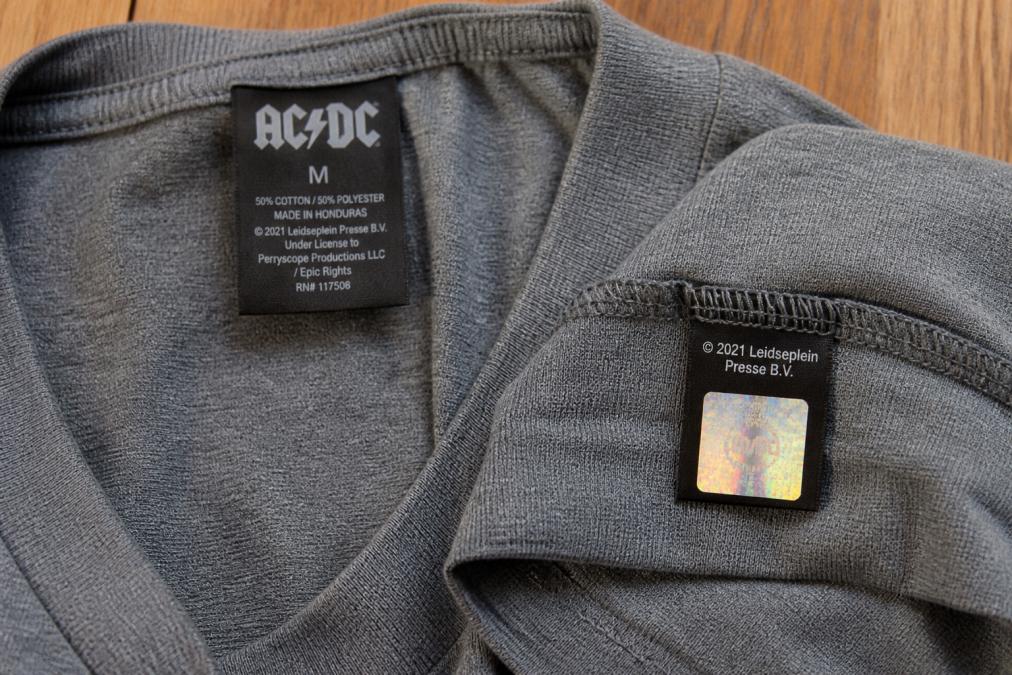
Close-up of the inside collar tag and hem label of a band t-shirt laid flat on a wooden surface under bright natural light, showing copyright text and licensing label.
What an Authentic Licensing Label Looks Like
A genuine licensing label includes the band's name, the copyright symbol (©), the year of production, and the name of the rights holder or licensing company. You'll often see language like "Manufactured under license from [rights holder]." The garment brand (Gildan, Fruit of the Loom, Anvil) will also be identified.
Bootleg shirts frequently omit copyright information entirely or include vague, generic text that doesn't reference a specific rights holder. Some counterfeits copy the look of a licensing label but get details wrong: misspelled band names, incorrect copyright years, or missing trademark symbols. Flip the collar on any shirt you're unsure about and read every word carefully.
According to the U.S. Copyright Office's guidance on licensing, the rights to reproduce an artist's image or logo on merchandise are controlled by the copyright holder, and any unauthorized reproduction constitutes infringement.
Digital Serial Number Verification
Some officially licensed products now carry serial numbers or QR codes on their tags that can be verified through the licensing company's website. Scanning the code or entering the serial number confirms the item was produced as part of an authorized run. Limited edition and collectible pieces are more likely to include this feature. If a seller claims an item is part of a limited run and it has no verifiable serial number, treat that claim with skepticism.
Step 2: Examine the Print Quality, Artwork, and Fabric
Print quality tells the story immediately. Officially licensed merchandise is produced by manufacturers with contractual obligations to meet quality standards set by the artist's team. Bootleg operations have no such obligation.
Screen Printing Clarity and Artwork Resolution
Authentic screen printing on licensed band apparel is sharp, with clean edges, consistent color saturation, and artwork that matches the band's official visual identity. The original artwork file used for licensed production is high-resolution, which means fine details reproduce accurately at garment scale.
Counterfeit prints show common failure modes: blurry or pixelated edges around logos, colors that look faded or off from the band's actual palette, ink that sits unevenly on the fabric, and artwork that's misaligned compared to official versions. Check the back of the print, on quality licensed shirts, the inside shows clean ink absorption without heavy bleed-through. On bootlegs, ink often bleeds through aggressively or sits as a stiff layer that cracks after a few washes.
Fabric Weight, Stitching, and Garment Construction
Official merchandise is produced on known garment blanks with documented fabric weights. A standard licensed band t-shirt typically uses mid-weight cotton or cotton-poly blend that feels substantial in hand. Bootleg shirts frequently use cheaper, lighter fabric that loses shape quickly.
Check the stitching at the collar, sleeves, and hem. Licensed garments use consistent double-stitching at stress points. Loose threads, uneven seams, or single-stitched hems that curl up are signs of low-quality construction that no authorized manufacturer would pass.
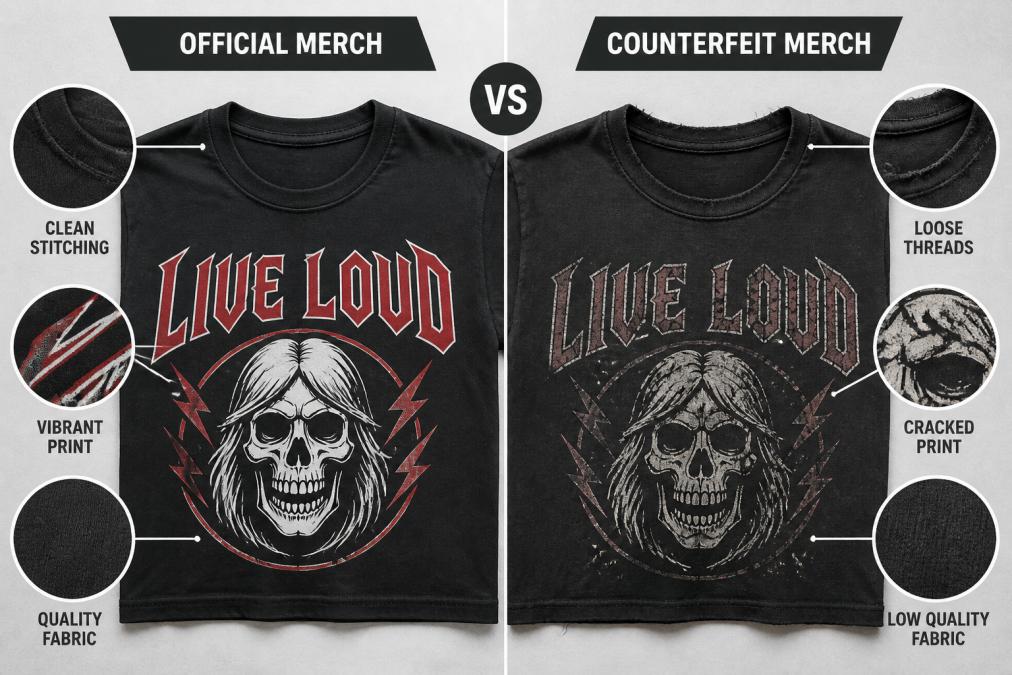
Close-up side-by-side of two band t-shirts laid flat on a light grey surface, one showing crisp vibrant screen-printed artwork with clean double-stitched seams, the other showing faded cracked print and loose threads along the collar, under even studio lighting
Step 3: How to Spot Fake Band Shirts When Shopping Online
Shopping online for band apparel requires different skills than examining a physical item. You can't feel the fabric or check the tag before buying, so you need to read listings carefully and understand the platform you're using.
Counterfeit sellers often use stolen images from official stores, meaning the photo looks perfect while the item that arrives is a cheap imitation.
Marketplace-Specific Red Flags
Watch for these warning signs:
- Seller has no established history with music merchandise or a very short account age
- Product listings use vague language like "band-inspired" or "graphic tee" rather than explicitly stating the item is officially licensed
- No mention of a licensing agreement anywhere in the listing
- Images appear professionally shot but the seller has no verifiable connection to an official retailer
- Multiple listings for the same design at dramatically different price points from different sellers
The FTC's guidance on deceptive advertising practices is clear that sellers cannot misrepresent the origin or authorization status of merchandise.
Comparing Prices: When a Deal Is Actually a Warning Sign
Officially licensed merchandise carries a price that reflects the licensing fee paid to the rights holder, quality garment blanks, and legitimate production costs. A shirt priced dramatically below what authorized retailers charge almost certainly cuts those costs by eliminating the licensing fee, which means it's bootleg.
The officially licensed band t-shirts at Rockteez Apparel are priced at $27.99, which reflects the actual cost of producing authentic merchandise on quality garment blanks. When you see a band shirt listed for a fraction of that price on an unfamiliar site, the most likely explanation is that no licensing fee was paid and no artist received any benefit.
A deal that looks too good is almost always a counterfeit.
Step 4: Verify the Seller Is an Authorized Retailer
Retailer authorization is the structural guarantee behind every authentic purchase. An authorized retailer has a direct relationship with the licensing company or the band's official merchandise partner.
To verify retailer authorization:
- Check the band's official website for a list of authorized merchandise partners
- Look for explicit "officially licensed" language on the retailer's product pages
- Search for the retailer's name alongside the band's name to see if there's documented official relationship
- Check whether the retailer carries merchandise across multiple major artists, which indicates established licensing relationships
The secondary market, including resale platforms and fan forums, requires extra caution. Items sold there may be authentic original purchases or counterfeits sold as authentic. Apply the tag and print quality checks from Steps 1 and 2 rigorously to any secondary market purchase.
The Real Benefits of Buying Licensed Music Apparel
The benefits of buying licensed music apparel extend beyond getting a better-quality shirt. The entire ecosystem of music merchandise exists because of the financial and legal infrastructure that licensing creates.
Supporting Artists Directly Through Official Purchases
Every officially licensed purchase sends a portion of the sale back to the artist or their estate through the terms of the merchandising agreement. For many artists, merchandise revenue is a meaningful income stream, particularly for touring musicians who rely on merch table sales and authorized online retailers.
Bootleg merchandise breaks that chain entirely. The money goes to the counterfeit producer, the artist receives nothing, and the fan ends up with an inferior product. Buying official band merchandise is a direct way to support the artists whose work you value.
Sustainability and Ethical Production Standards
Authorized manufacturers who hold licensing agreements are accountable to the licensing company, which means they face scrutiny over their production practices. Bootleg operations have no accountability and use whatever materials and labor practices are cheapest.
Official merchandise producers are subject to standard regulatory requirements that govern apparel manufacturing, and licensing companies increasingly include ethical sourcing standards in their agreements. According to the U.S. Department of Labor's resources on apparel industry labor standards, accountability in the supply chain starts with documented, legal business relationships, which counterfeit operations by definition lack.
Buying officially licensed band merchandise means your purchase was produced by someone who had to answer for how they made it.
How to Identify Official Band Merchandise at a Glance: Quick Reference
The table below summarizes the key verification steps covered in this guide.
Verification Step |
What to Look For |
Authentic Signal |
Counterfeit Signal |
|---|---|---|---|
Licensing tag |
Copyright text, rights holder name |
Full copyright details, manufacturer named |
Missing, vague, or misspelled information |
Holographic sticker |
Color-shifting optical effect |
Rainbow shift when tilted |
Flat, non-shifting printed imitation |
Print quality |
Edge sharpness, color accuracy |
Clean edges, accurate palette |
Blurry edges, faded or off-brand colors |
Fabric and stitching |
Weight, seam consistency |
Mid-weight fabric, double-stitched seams |
Thin fabric, loose threads, curling hems |
Seller authorization |
Official retailer status |
Documented licensing relationship |
No verifiable connection to rights holder |
Pricing |
Reflects licensing and production costs |
Consistent with authorized retailers |
Dramatically underpriced |
Digital verification |
Serial number or QR code (where present) |
Verifiable through licensing platform |
No serial number on items claiming limited edition status |
Quick checklist before any purchase:
- Does the tag include copyright text and a named rights holder?
- Is the screen printing sharp with accurate colors?
- Does the fabric feel substantial, with consistent double-stitching?
- Is the seller an authorized retailer with a verifiable licensing relationship?
- Is the price consistent with what authorized retailers charge?
- For limited edition items: is there a verifiable serial number?
If you can check all seven boxes, you're looking at official band merchandise. If two or more fail, walk away.
The Rockteez Apparel catalog of officially licensed band shirts, including the AC/DC Dark High Voltage Official Heather T-Shirt and the Aerosmith Rollin' Official Heather T-Shirt, passes every one of these checks by design. Each piece is produced under a valid licensing agreement, carries proper copyright labeling, and is printed on quality garment blanks with an athletic fit.


Frequently Asked Questions
How do I know if band merch is officially licensed?
Officially licensed band merchandise carries a licensing label inside the garment, usually near the collar or hem, that includes copyright and trademark information along with the name of the authorized manufacturer. The artwork should be crisp and high-resolution, the fabric should feel substantial, and the seller should be an authorized retailer.
How can I spot a bootleg band shirt?
Bootleg band shirts typically show several warning signs: blurry or cracked artwork, missing or generic licensing tags, very low prices that undercut official retail, and sellers with no verifiable authorization. On secondary marketplaces, watch for stock photos instead of real product images, vague descriptions with no mention of licensing, and seller accounts with little history. Counterfeit shirts also tend to use lighter, cheaper fabric with uneven stitching along the seams and collar.
Is band merch sold on third-party marketplaces usually legit?
Not always. Third-party marketplaces host both verified sellers and counterfeit operations side by side. To stay safe, check whether the seller is explicitly listed as an authorized retailer, read recent reviews carefully for mentions of print quality or tag authenticity, and compare the listing price against the band's official store. If the price is significantly lower with no sale explanation, treat it as a red flag. Buying directly from an authorized retailer removes that uncertainty entirely.
Why does it matter if band merchandise is officially licensed?
Purchasing officially licensed band merchandise means a portion of the sale goes back to the artist through the merchandising agreement. Bootleg sales generate zero revenue for the band and infringe on their intellectual property and trademark rights. Beyond supporting the artists financially, licensed products are held to consistent production quality standards, so you get better fabric, accurate artwork, and a garment that holds up over time. It's the difference between a collectible and a cheap imitation.